Prince Rupert zu Loewenstein - obituaryPrince Rupert zu Loewenstein was a Bavarian aristocrat and banker who disliked rock and roll but made The Rolling Stones very rich  http://i.telegraph.co.uk/multimedia/archive/02917/loewenstein_2917999b.jpg
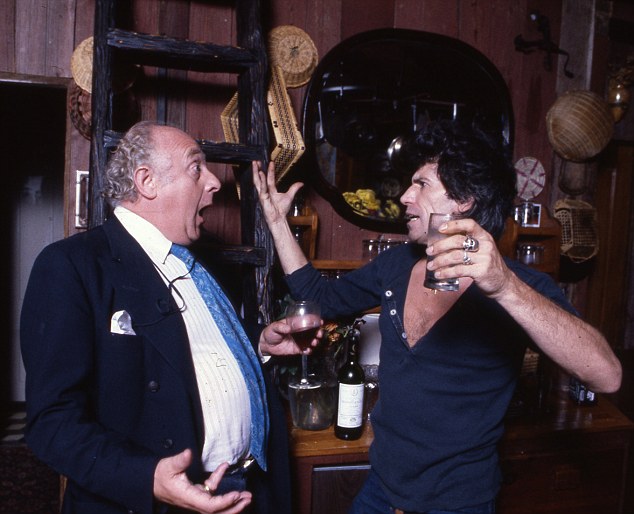
Prince Rupert zu Loewenstein with Keith Richards of the Rolling Stones
Photo: REX
5:41PM BST 21 May 2014Comments1 Comment
Prince Rupert zu Loewenstein, who has died aged 80, was the Bavarian aristocrat who for decades managed the financial affairs of The Rolling Stones.
Loewenstein was a key member of the Stones’ entourage for almost 40 years. The subfusc banker’s suits and high Roman Catholic connections which made him such an incongruous figure amid a backstage ambience of sex, drugs and rock and roll were in some ways deceptive: he had a lively sense of humour, and he observed his clients’ antics with a worldly twinkle in his eye. “He’s a bit of a showman, a bit extraordinary,” one City colleague said of him. “He always lived life at a very high rate.”
 http://i.telegraph.co.uk/multimedia/archive/02918/loewenstein_jagger_2918011c.jpg
Prince Rupert zu Loewenstein with Mick Jagger (JAMES YEATS-BROWN/MUSIDOR BV)
It was as managing director of Leopold Joseph & Co, a small London merchant bank, that he was first introduced to Mick Jagger by a mutual friend, the art dealer Christopher Gibbs, in 1968 — though Loewenstein claimed at the time never to have heard of the band. Jagger — no slouch in financial matters himself — was increasingly angry at the handling of the Stones’ affairs by Allen Klein, the aggressive New Jersey accountant who had been the group’s manager since 1965 and whose terms included a 50 per cent slice of their recording royalties. “Half the money I’ve made has been stolen,” Jagger later told an interviewer — and his first question to Loewenstein was whether the skills of Leopold Joseph could extricate them from their contract with Klein.
“I discussed taking on the group with my partners but they were very much against any involvement, saying it would be bad for the image of the firm,” the prince recalled. “It was very hard to win them over, but I finally prevailed.”
Loewenstein later wrote that he and Jagger “clicked on a personal level. I certainly felt that [he] was a sensible, honest person. And I was equally certain that I represented a chance for him to find a way out of a difficult situation. I was intrigued. So far as the Stones’ music was concerned, however, I was not in tune with them, far from it. Rock and pop music was not something in which I was interested ... After the first two or three business meetings with Mick, I realised there was something exceptional in his make-up, that his personality was able to convert his trade as itinerant performer into something far more intriguing.”
 http://i.telegraph.co.uk/multimedia/archive/02918/loewenstein_keef_2918015c.jpg
Prince Rupert zu Loewenstein with Keith Richards (KEN REGAN/CAMERA 5)
From then on, Loewenstein was a particularly close personal adviser to Jagger, who developed a liking for rubbing shoulders with high society. Shortly after they met, Jagger helped to plan a White Ball at the Loewensteins’ home in Holland Park, which kept neighbours awake until a quarter to six in the morning. When one rang the police to complain, she was told: “We can’t do anything about it, Princess Margaret’s there.”
Loewenstein realised that a great deal more money could be made for the band from touring: “After reviewing a few of the basic documents, I realised [the money] would have gone to Klein and therefore they would have depended on what he gave them, as opposed to what the record company or the publishing company did. They were completely in his hands. What had also become apparent to me was that the band would have to abandon their UK residence. If they did not do this, they could be paying between 83 and 98 per cent of their profits in British income tax and surtax. I selected the South of France as a suitable location for them.”
By 1972 Loewenstein had managed to reach a satisfactory contract with Allen Klein (although litigation continued for a further 18 years), allowing the Stones to record with a company of their choice. He then set himself to find a new recording contract for them to replace the existing one with Decca; during their European tour of 1970 he conducted what amounted to a trade fair on their behalf from a series of hotel bedrooms.
The prince’s services extended not only to managing their money, negotiating their contracts and accompanying them on tour: he once described himself as “a combination of bank manager, psychiatrist and nanny”, while the tabloids christened him “Rupie the Groupie”. In 1978 he was called upon to provide an affidavit to a Toronto court as to the extent of Keith Richards’s casual spending — $350,000 in the previous year — as evidence that the guitarist was wealthy enough not to commit crimes in order to feed his heroin habit.
It was the prince who was most influential in persuading Jagger to go on touring through the 1980s and ’90s, as relations among the group members cooled and the wear and tear of advancing age took its toll. The prince also stood as godfather to James, Jagger’s son by Jerry Hall, in 1985 (the actress Anjelica Huston was godmother).
When Jagger and Hall parted, Loewenstein masterminded the financial settlement that followed — and remarked in a rare interview that “when families split up you have to make it absolutely clear whose side you are on at once”. It was due in large part to his wisdom that Jagger’s fortune is today estimated at more than £200 million.
 http://i.telegraph.co.uk/multimedia/archive/02918/loewenstein_duches_2918025c.jpg
Prince Rupert zu Loewenstein with the Duchess of York (REX)
Rupert Louis Ferdinand Frederick Constantine Lofredo Leopold Herbert Maximilian Hubert John Henry zu Loewenstein-Wertheim-Freudenberg was born at Palma, Majorca, on August 24 1933.
His father, Prince Leopold, a native of Salzburg, traced descent through the royal house of Wittelsbach from the Elector Palatine Friedrich I (1425-76), whose son Ludwig — by a mistress, Clara Tott, whom the Elector married to legitimise the child — became Count of Loewenstein, near Heilbronn in what is now Baden-Wurtemberg, in 1488. Rupert’s mother was a daughter of the Count of Treuberg, and the family’s connections could be traced throughout the Almanack de Gotha. Non-noble forebears included the Frankfurt financier Mayer Amschel Rothschild, founder of the famous banking dynasty.
The young Rupert was brought to England in 1940 and sent to Beaumont, the Roman Catholic public school. Later he read History at Magdalen College, Oxford — where he emerged as one of the glitterati of his generation — and began his City career as a trainee with the stockbrokers Bache & Co. He and a group of friends swiftly decided that the best way to make serious money would be to own their own merchant bank.
Together with, among others, Jonathan Guinness (now Lord Moyne), the exotic French Baron Alexis de Redé, and Anthony Berry ( son of the Sunday Times proprietor Lord Kemsley and later a Conservative MP who was killed by the 1984 Brighton bomb), he arranged to buy Leopold Joseph & Co from its founding family for £600,000.
The bank had been set up in 1919 by a German-Jewish immigrant who first came to London as a reporter for the Frankfurter Zeitung; three Joseph brothers remained in the business, which had been operating on a very modest scale.
Under Loewenstein’s leadership, it rapidly made a new name for itself in lucrative corporate finance work and investment advice for very wealthy private clients. His success with the Rolling Stones’ account brought him a number of other showbusiness clients, including Pink Floyd and (before his conversion to Islam) Cat Stevens.
In 1981 the prince left Leopold Joseph to set up his own business, Rupert Loewenstein Ltd, based in St James’s. He took his best clients with him, and once explained why he enjoyed working for people who had only recently made their fortunes. New money, he said, was “much more interesting than old. People with old money are nearly always having to be adjusted downwards.”
Loewenstein’s own money, both old and new, enabled him to live in grand style in later years in a former grace-and-favour mansion, Petersham Lodge — not far from the Jagger ménage on Richmond Hill — which he bought in 1987 for around £2 million.
But in parallel with a life of money and parties, there was also a spiritual side to him. He petitioned for the preservation of the Tridentine Mass — writing to The Daily Telegraph in 1975 about its numinous beauty — and held high office in ancient Catholic orders of chivalry: he was Grand Inquisitor of the Constantinian Military Order of St George and president of the British association of the Sovereign Military Order of Malta.
Loewenstein’s association with The Rolling Stones ended amicably in 2007 — although his publication six years later of a memoir, A Prince Among Stones, was said to have upset Jagger.
In the book, the prince wrote of his relationship with the band: “All the time I worked with the Stones I never changed my habits, my clothes or my attitudes. I was never tempted by the rock ’n’ roll lifestyle. Although I enjoyed a good vintage wine, I was never a heavy drinker, nor a drug-taker. I always aimed to maintain a strict discipline backstage, for security reasons, and tried to see that the band and the entourage did not get drunk or disorderly.
“To many outsiders it must seem extraordinary that I was never a fan of the Stones’ music, or indeed of rock ’n’ roll in general. Yet I feel that precisely because I was not a fan, desperate to hang out in the studio and share in the secret alchemy of their creative processes (something I never did since I couldn’t take the noise levels), I was able to view the band and what they produced calmly, dispassionately, maybe even clinically – though never without affection.”
 http://i.telegraph.co.uk/multimedia/archive/02918/loewenstein_wife_2918042c.jpg
Prince Rupert zu Loewenstein with his wife Josephine hosting The White Ball
Prince Rupert married, in 1957 at the London Oratory, Josephine Lowry-Corry, a barrister’s daughter who had trained as a ballet dancer at Sadler’s Wells until she grew too tall, then retrained as an opera singer. The best man was Prince Rupert’s cousin Prince Johannes von Thurn und Taxis, and the honeymoon included a visit to the Wagner festival at Bayreuth.
The Loewensteins had two sons, Princes Rudolf and Konrad, both of whom became priests, and a daughter, Princess Maria-Theodora (Dora), who married an Italian count, Manfredi della Gherardesca, and became a director of her father’s business.
Prince Rupert zu Loewenstein, born August 24 1933, died May 20 2014
http://www.telegraph.co.uk/news/obituaries/10847031/Prince-Rupert-zu-Loewenstein-obituary.html